Trump waived a 100% tariff on Russia's top oil and gas buyers. Rubio named India
The order names no buyer. China and India, the top buyers in importers' 2025 UN returns for Russian crude, sold the US $359bn of goods in the year to August.
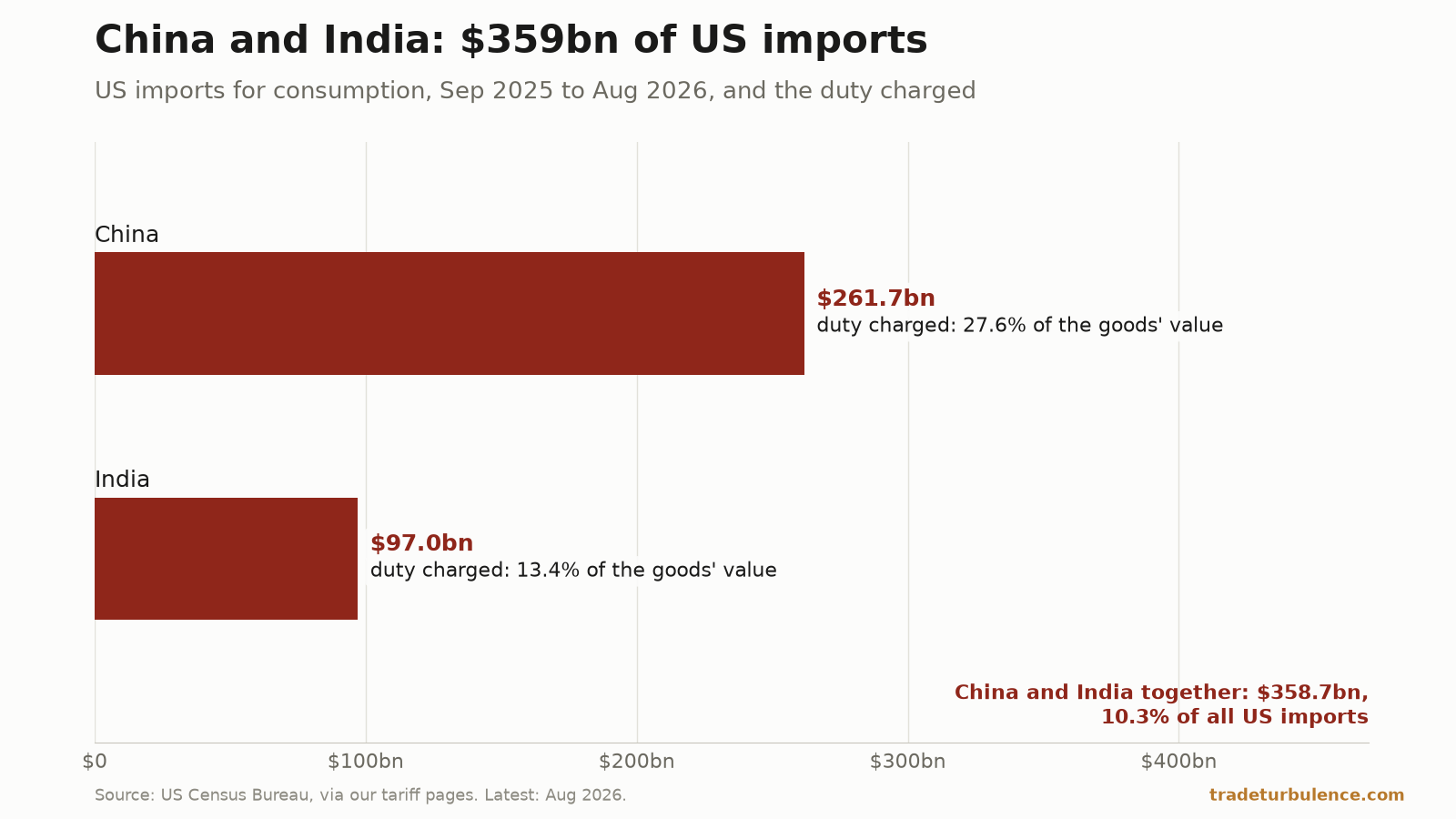
An order Donald Trump posted on Friday evening, 16 October, raises the duty on goods from the five largest importers of Russian crude and gas by 100%, on top of other duties and with the Graham Act’s exceptions, if they knowingly make new purchases from 18 October, and waives it, certifying the waiver “in the national interests of the United States”. It names no buyer. In importers’ 2025 UN returns, China and India declared 93.6% of the Russian crude reported. The US imported $359bn of their goods in the 12 months to August, a tenth of its imports.
What Trump wrote in the order
As described further in section 4 of this order, I am hereby waiving the application of such sanctions, restrictions, and duties provided for in the Graham Act. I have submitted to the Congress a certification that the issuance of such a waiver at this time is in the national interests of the United States.
The executive order, posted at 20:34 US Eastern, sets duties the Lindsey O. Graham Sanctioning Russia and Iran Act allows at “up to” 500% and 100%: 500% on goods from Russia, 100% on “the largest 5 importers” of Russian crude and gas and on the top five facilitators of sanctions evasion. Section 4 waives them, the Act’s sanctions in sections 102 to 111 and its termination section, 117, until the President or the Secretary of State “determine that further action is appropriate”. The Act, named for the late Senator Lindsey Graham, allows a waiver on a certification and a report to Congress; neither had been published by the cutoff below.
The White House’s case, on the record
Secretary of State Marco Rubio told reporters at Joint Base Andrews on 17 October that “the problem is these sanctions were not just sanctions on Russia. They include tariffs on a number of countries – India, for example, and others. And so I think the President wants to take the 60-day period of time to sort of analyze what imposing both sanctions and tariffs will mean to the global economy and even to the U.S. economy”. On why the Act has waivers, he said: “I think when the bill was passed, one of the reasons the waivers were put in there is understanding that they would need some period of time to study this, given all the different things that are going on in the world right now, including the pressure on global energy supplies”, which he traced from Iran to the war in Ukraine. “And so that’s having an impact on global prices as well.” India, he said, is among countries “that have voluntarily diversified their energy portfolio but are still getting a substantial amount of energy from Russia because it’s hard to pivot from one day to the next”, and is “an important ally and partner of the United States”.
A White House spokesperson, Taylor Rogers, said in a statement on Saturday, as quoted by ABC News and Newsweek: “Enforcing the sanctions provisions now would impede ongoing U.S. efforts to negotiate a durable and comprehensive peace agreement between Ukraine and Russia. The President retains the ability to exercise these authorities at any time if he determines that doing so would advance national interests.”
Asked by reporters at Mar-a-Lago that evening why he waived the sanctions, Trump said, as quoted by NBC News and TASS: “A lot of you don’t know what my decision is yet, but we’ll figure it out, and you’ll figure it out.” “It’s a very good decision, and it’s going to be a decision that’s good for the country, and I think good for the world because we’re really at a world stage,” he said.
The Act’s backers in Congress, on the record
The Senate passed the Act 86–11, rejecting 64–32 an amendment to strike the buyer tariffs; the House agreed 262–159. Senator Darline Graham, the late senator’s sister, sponsored it in the Senate.
On 13 October, 12 senators of both parties, among them Richard Blumenthal, Mitch McConnell and Thom Tillis, wrote to Trump about his Russian diesel licence and the Act: “These authorities require you to apply economic pressure on Russia and the chief enablers of its war, in particular China, and thereby enhance your negotiating position to bring a swift end to this ruinous conflict”, as quoted by CNBC and CBS News. On 15 October 22 House members of both parties, among them Michael McCaul and Jim Costa, wrote that using its tools for economic pressure “will be decisive in forcing Putin to take peace talks seriously”, and asked “that any waiver be narrow, time-limited, and tied to measurable reductions in support for Russia’s war, and that no waiver be used to defer the law’s core provisions”.
After the order, Tillis wrote on X, as quoted by ABC News and Newsweek: “What part of enforcing a law passed 86-11 by the Senate does the President and his advisors not understand?” Darline Graham said at a campaign stop on Saturday that she and Trump “share the same goal” and, NBC News reported, that it was up to him whether to use the law; but, speaking for herself, as quoted by CNN and NBC News: “I would choose to keep the pressure on Russia to end the war and get the gas prices down because I don’t trust Putin and I don’t trust Russia”.
Ukraine’s case, on the record
Ukraine’s president, Volodymyr Zelensky, wrote in an English post on X on 17 October, as quoted by CBS News and Newsweek: “A U.S. sanctions blackout, easing pressure on the aggressor, financial rewards for Putin - all of this only encourages him to keep attacking”. In a later English post on X, as quoted by ABC News and CNBC: “The decision to undo all of this, to block all of it, seems wrong to me. And it definitely helps only the Russians.”
Russia’s case, on the record
Kirill Dmitriev, an envoy of Vladimir Putin, posted at 07:30 Moscow time on 17 October: “The suspension of some of the provisions of the Graham Act marks an important and truly historic moment.” The law, he wrote, “could have effectively brought all economic cooperation between Russia and the United States to a complete halt, inflicting serious damage primarily on the U.S. economy and global markets”. The Kremlin’s website carried no comment on the waiver.
China’s and India’s case, earlier, on the record
Neither government, nor Türkiye’s, had responded publicly to the waiver by the cutoff. On 17 September, after the House vote, India’s External Affairs ministry said that “India remains firmly committed to ensuring energy security for its 1.4 billion people” and would “continue to do so through diversified sourcing and on the basis of evolving market dynamics”, as quoted by Deccan Chronicle and DTNext. It had “made clear its determination to take all necessary measures to protect its trade and economic interests” (BusinessToday, The Pioneer).
China’s foreign ministry spokesperson, Guo Jiakun, said the same day: “China engages in normal economic and trade cooperation with other countries on the basis of equality and mutual benefit. … China opposes long-arm jurisdiction and unilateral sanctions that have no basis in international law and lack UN Security Council mandate.”
This piece reflects the public record to 17:03 IST on 18 October 2026 (07:33 US Eastern).
China and India sold the US $359bn; Russia supplied over half of India’s July crude
On the site’s tariff pages, from Census records, the US imported $261.7bn of goods from China in September 2025 to August 2026, the latest month on those pages, and charged duty worth 27.6% of their value (China’s page). From India it imported $97.0bn and charged 13.4% (India’s page). Together that is $358.7bn, 10.3% of everything the US imported, at an average 23.8%.
The order does not say which five countries. The Act’s test is the five largest importers “by total volume” of Russian crude (HS 2709) or gas (HS 2711) in the 12 months before 18 September. Importers’ own 2025 returns to UN Comtrade put China, at 100.9m tonnes of Russian crude, and India, at 88.7m, far ahead; the third, Slovakia, declared 5.1m. That is a calendar-year ranking, not the Act’s window. Türkiye, listed by CBS News, has no crude rows in its 2025 return, so the data cannot place it.
India’s own customs returns test Rubio’s description and India’s “diversified sourcing”. Russian crude was 38.1% of India’s crude imports by weight in 2024 and 33.7% in 2025, and fell to 20.6% in January 2026. Then it rose. In July 2026, the latest month India has filed, Russia supplied 11.46m tonnes, 53.7% of India’s crude imports, the largest volume and the highest share in India’s monthly returns since at least January 2021, though July and August 2023 have no world total to compare.
What this cannot settle
Which five countries, and which goods. No US determination or methodology had been published. A country’s knowing new purchases trigger the 100 points, which fall on its goods, with the Act’s exceptions for food, agricultural goods, medicine and medical devices, among others. $359bn is past trade, not the duty’s base or a forecast.
Why the waiver was issued, beyond the parties’ words. The report to Congress had not been published by the cutoff, and whether enforcement would help peace talks is beyond this data.
What to watch
Rubio in India, to 22 October. In Mumbai and Jamnagar he is to “discuss prospects for enhanced energy cooperation”, the State Department says.
15 December. If Rubio’s 60 days run from the order’s date, they end then; the order names no date.