The rupee fell through a rate rise, then rose 1.4% in two fixings
Three of the RBI archive's four weakest rupee fixings came on 7–9 October. From the 9th to the 13th, across five policy announcements, the rupee gained 1.4%.
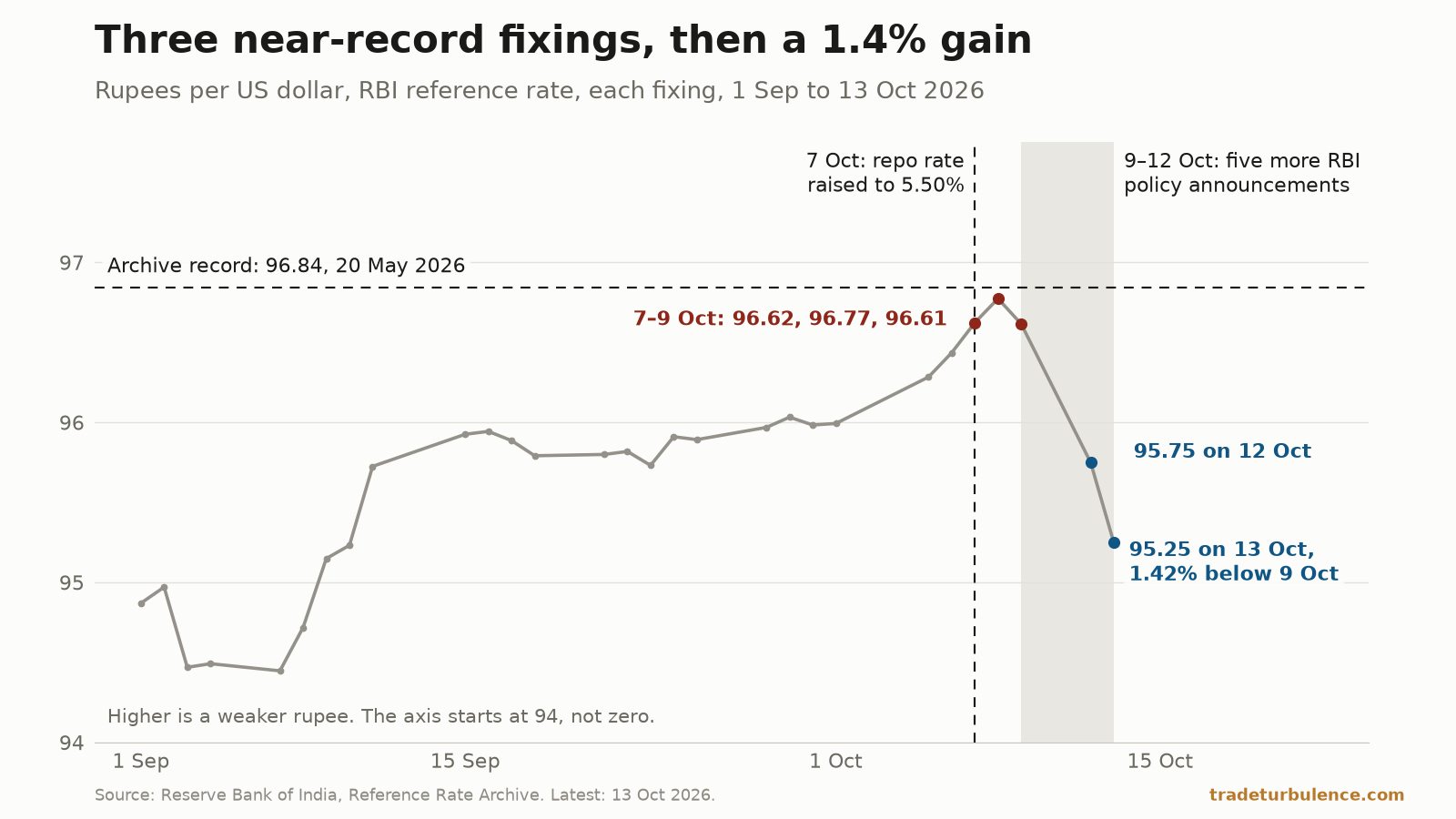
The Reserve Bank of India raised its repo rate to 5.50% on 7 October 2026. The rupee’s reference-rate fixings of that day and the next two, 96.62, 96.77 and 96.61 to the dollar, are three of the four weakest among the 5,898 in the bank’s archive. From 9 to 12 October the RBI made five more policy announcements, two on bank liquidity and three on the foreign exchange market, one of them a dollar window for three public-sector oil companies. The fixings of 12 and 13 October were 95.75 and 95.25, a fall of 1.42% from 9 October’s.
The fixings of 7, 8 and 9 October are three of the four weakest in the archive
The Monetary Policy Committee, which sets India’s policy rate, voted unanimously on 7 October to raise the repo rate by 25 basis points to 5.50% and changed its stance to “calibrated tightening”; two members wanted the stance kept at neutral.
The RBI’s own Reference Rate Archive returned a rupee-dollar rate for 5,898 days between 25 August 1998 and 13 October 2026, with nothing for 10–23 July 2018 or from 25 July 2018 to 11 April 2022. The rate is a fixing, not a closing price. The public feed of Financial Benchmarks India (FBIL), asked for 1 September to 13 October, returned 24 days ending on 6 October, each stamped 13:00 and each equal to the archive’s rate. Every series in this piece is in rupees per dollar, so a lower number is a stronger rupee.
On the RBI’s fixing the rupee was weakening before the decision. The rate rose 0.30% on 5 October, from 1 October’s, and 0.16% on 6 October, to 96.43. On the day of the decision it was 96.62, up 0.20%; the next day 96.77, up 0.16%; and on 9 October 96.61. Over the two fixings before the decision the rate rose 0.46%, and over the two from it 0.35%. Among the archive’s rows the fixings of 7, 8 and 9 October rank third, second and fourth. Only 20 May 2026 is higher, at 96.84, and 8 October came within 0.07 of it. The documents read for this piece give no clock time for the announcement on 7 October: the Governor’s statement opens “Good morning”, the press conference “Good afternoon”.
A second source gives the same order. The cross of the European Central Bank’s euro reference rates for the rupee and the dollar is 96.73, 96.78 and 96.73 on the same three days: also third, second and fourth in a series that starts in January 2000, behind 96.825 on 20 May. The ECB’s rates are set hours after the 13:00 stamp, and the two sources have differed by a median of 0.06 rupees over the past 250 common days. No change in this piece is measured from one source to the other.
The weekly of 12 October said the site had not tested whether the decision moved the currency. On both sets of fixings the rupee was weaker on each of the three days than on 6 October.
The resolution and the Governor’s statement say little about the exchange rate. The resolution does not contain the word “rupee”. The Governor’s statement gives the exchange rate one sentence: “We remain committed to ensuring orderly adjustments to the exchange rate that are in sync with the underlying macroeconomic fundamentals and curbing excessive volatility.” At the press conference that afternoon the Governor, Sanjay Malhotra, said more. Asked whether there would be further steps, he replied: “As I mentioned to you, we will ensure that the rupee stabilizes, that the rupee finds its correct value, and we will support the rupee in an orderly movement of the rupee and in finding its correct value, and at the same time, in ensuring that there is no excessive volatility.” Earlier, listing what would drain banks’ surplus cash, he had named “the spot intervention that we do to support the rupee”.
From 9 to 12 October the RBI made five more policy announcements
The RBI files what it does in separate lists: press releases, notifications to banks, speeches and media interactions. Some measures appear only as notifications. Read together at 17:05 Indian time on 13 October, the lists carry five announcements of policy dated 9 to 12 October, two on bank liquidity and three on the foreign exchange market. That count leaves aside the auctions at which the central and state governments borrow, the reverse-repo auctions the RBI held on every working day from 7 to 13 October, data and survey releases and supervisory orders. The line between the open-market sale, which is counted, and the reverse-repo auctions, which are not, is this piece’s own:
- 9 October. An open-market sale of government securities for ₹25,000 crore, to be held on 13 October, “On a review of current and evolving liquidity conditions”.
- 9 October, stamped 17:45 in the RBI’s notifications feed. Banks' minimum daily balance against the cash reserve ratio goes from 90% to 99% of the requirement from the fortnight beginning 16 October, “On a review of the current liquidity conditions”.
- 10 October, a Saturday. Four rules on rupee derivatives, issued “In view of the evolving conditions and to ensure orderly functioning of the foreign exchange market”: a cancelled contract may not be rebooked; the position that needs no proof of an underlying exposure is cut from $100m to $5m, over the counter and on exchanges; a user must undertake that the same exposure is not hedged with a second dealer; and dealers must hold with the RBI, in cash, 20% of the notional amount of each contract above $2m that hedges a current-account exposure in which the user buys foreign currency.
- 10 October. A window “to meet the entire daily dollar requirements of three public sector oil marketing companies”, Indian Oil, Hindustan Petroleum and Bharat Petroleum, under which the RBI “will undertake sale of USD” to them through designated banks, in effect from 12 October “until further notice”.
- 12 October, stamped 23:55. A third circular on rupee derivatives: dealers may offer non-deliverable contracts to non-residents “only for the purpose of hedging”, and the 20% cash reserve now also covers contracts a dealer takes to hedge its own books when it buys foreign currency against the rupee. The press-release list carried nothing for it.
The first four are dated before the 12 October fixing and the fifth is stamped between the fixings of 12 and 13 October. The bond sale took its bids from 9:30 to 10:30 on the morning of 13 October.
None of these documents gives a size or an end date for the window, and none mentions any level of the rupee. For scale, the RBI’s weekly supplement of 9 October put India’s foreign exchange reserves at $734.6bn on 2 October, $13.0bn less than a week earlier. A change in reserves includes changes in the value of what is held, so that is not a figure for dollars sold.
On 12 October the rupee gained more than any of 28 other currencies
The reference rate of Monday 12 October, the day the window was to take effect, was 95.75, 0.90% below that of 9 October. On the ECB’s cross the fall between the same two days was 0.99%, from 96.73 to 95.77, and the two sources were 0.03 apart on the level.
The ECB publishes rates for 28 currencies besides the dollar. Put per dollar, and with the euro added, that makes 29. Between the ECB’s rates of 9 and 12 October 20 of the 29 weakened against the dollar, the euro by 0.22%, and the median move was a loss of 0.21%. The rupee’s gain was the largest of the 29, ahead of the Korean won’s 0.63% and the Brazilian real’s 0.25%. The rupee’s move that day was not a general fall in the dollar.
On 13 October, after the third circular, the reference rate fell again, to 95.25, a further 0.52%. Measured from the 9 October fixing, the last before the announcements of 10 October, the fall is 1.37 rupees, or 1.42%. That is the lowest fixing since 10 September, 1.23% below the 6 October rate and 1.60 rupees below the archive’s record.
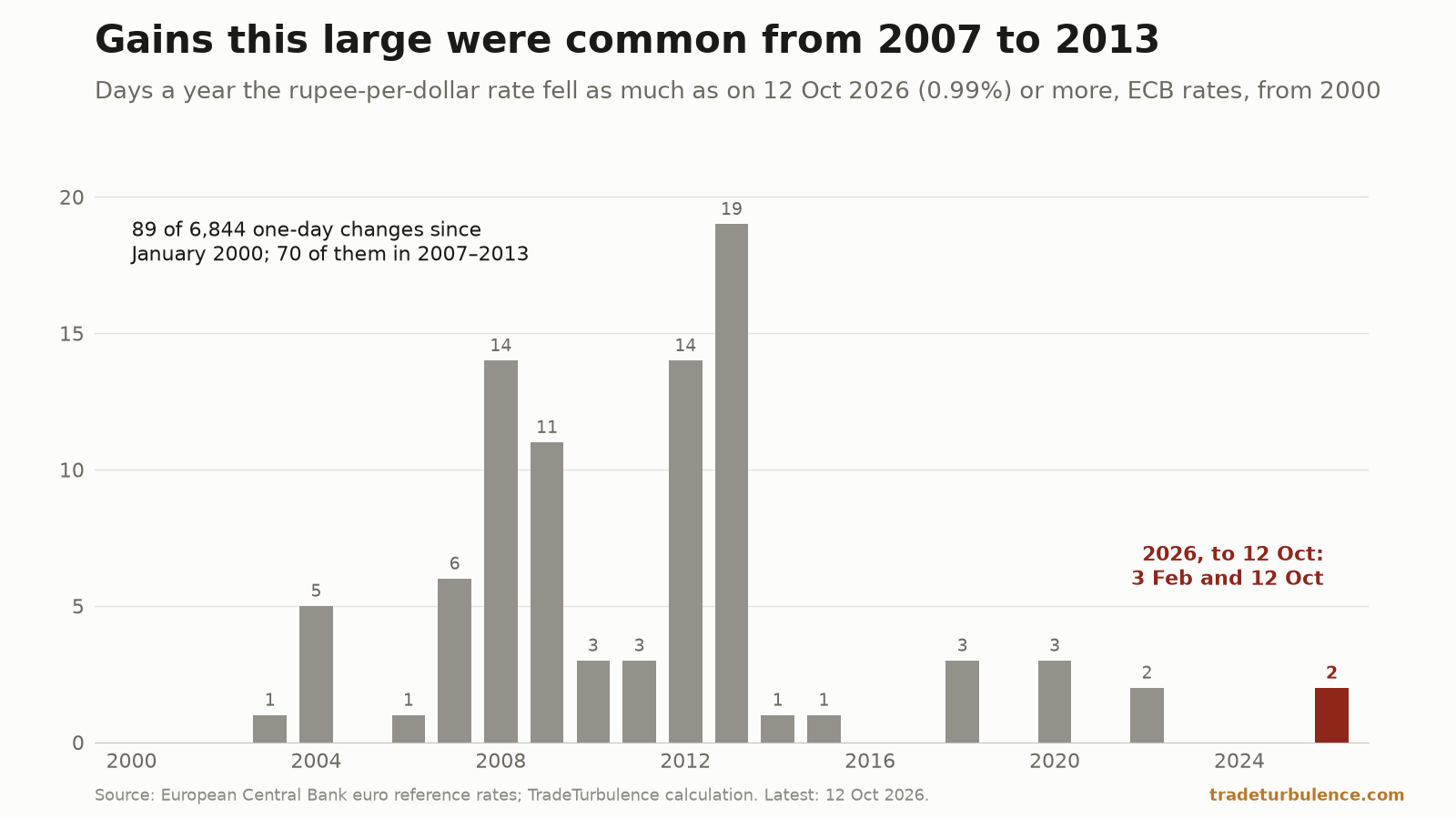
A gain this size is not rare, and the site’s own file makes it look rarer
In the file behind the site’s rupee page, as built on 13 October at 02:15 UTC, 12 October’s −0.99% is the second-largest one-day fall of the five-year daily window, after 3 February 2026. That ranking does not hold. That build carries the Federal Reserve’s daily rate to 2 October and the ECB cross from 5 October, and the two do not move by the same amount on the same day: on 3 February the Fed’s rate fell 1.32% and the ECB cross 1.56%.
On the ECB cross alone, 12 October’s 0.99% is the fourth-largest one-day fall of the five years to that date, behind 3 February 2026 and 11 and 4 November 2022. Over the whole series from January 2000 to 12 October 2026, 89 of 6,844 one-day changes were falls at least that large, 12 October included: one in 77. They are bunched. Of the 89, 70 came in the seven years from 2007 to 2013, 19 of them in 2013 alone, and 12 in the years since.
The RBI’s own fixing shows the same at its own size, 0.90%. From April 2022, where the archive resumes after its long gap, five changes from one fixing to the next were larger than that, two of them in 2026: 1.53% on 2 April and 1.30% on 3 February. A two-fixing fall as large as the 1.42% to 13 October has ended on five dates since April 2022, all of them from May 2025 on. The one before this, to 6 April 2026, was 1.69%.
The Fed’s series has no change for 12 October to rank: its last row was 2 October when it was fetched on 13 October. In its history from 1973, 214 of 13,472 one-day changes were falls at least as large as the ECB cross’s on 12 October, and 272 were at least as large as the RBI fixing’s.
A similar window opened in 2013 on the day of a record
The RBI has supplied dollars to the oil companies before. On 28 August 2013 it announced “a forex swap window to meet the entire daily dollar requirements of three public sector oil marketing companies (IOC, HPCL and BPCL)”. That day’s reference rate, 68.36, was the highest the archive had recorded to that date. The next two fixings were 67.71 and 66.57, a fall of 2.61%, and the archive shows no rate above 68.36 until 12 February 2016.
The comparison is loose. The 2013 release describes “sell/buy USD-INR forex swaps for fixed tenor”, a sale reversed at a later date; the 2026 release describes “sale of USD”. Other measures came close behind in 2013, as they did in October 2026: a release of 4 September 2013 offered banks a window to swap fresh foreign-currency deposits. And 2013 was not the first such facility. On 30 May 2008 the RBI said it would conduct open market operations in the oil bonds held by public-sector oil companies, “subject to an overall ceiling of Rs.1,000 crore on any single day”, and “provide equivalent foreign exchange through designated banks at market exchange rates to the oil companies”. It called the measures “ad hoc, temporary in nature”. These are two earlier episodes, not a full list, and neither is evidence of what the rupee does next.
What this cannot settle
The data dates the gain. It does not name the cause. Five policy announcements fall between 9 and 12 October, and two fixings cannot separate them. Nor can the fixings separate any of them from the RBI’s own dealing in the market, which the Governor described on 7 October as “the spot intervention that we do to support the rupee” and which no figure in this piece measures. The reference rate was already 0.16% lower on 9 October than on 8 October, before the announcements of 10 October. Brent’s last print in FRED’s series was 6 October when it was fetched on 13 October, so this piece gives no oil price for those days. India’s September inflation, 5.54% against 4.83% in August, was embargoed until 4 pm on 12 October. If that day’s reference rate was stamped 13:00, as on every day FBIL’s feed returned, it came before the figure. The ECB’s rate came after: the ECB says its rates rest on a procedure that “normally takes place around 14:10 CET”, which is 17:40 in India by Frankfurt’s clock that day and 18:40 if “CET” is read strictly. The RBI’s documents state purposes, not effects.
The RBI has put no number on the window. Its release gives no size and no end date. When its lists of press releases, notifications, speeches and media interactions were read at 17:05 Indian time on 13 October, no title dated after 10 October named the window, and the only foreign exchange item dated 11–13 October was the circular of 12 October. Reserves, the nearest published measure, appear in a weekly supplement that was seven days behind on 9 October, and they move with valuations as well as sales.
A fixing is one moment of the day. The reference rate and the ECB’s rate were 0.03 apart on 12 October and 0.12 apart on 9 October, and neither is a closing price. The market can trade above a fixing: at the RBI’s press conference on 7 October a questioner from CNBC TV18 said, “We’re at ₹96.83.” No fixing of that week is as high. As fetched at 17:47–17:48 Indian time on 13 October, the RBI’s archive ended on 13 October, the ECB series on 12 October and the Fed’s on 2 October.
The archive has gaps, and two fixings are not a trend. The Fed’s series, which covers the years the RBI’s archive lacks, peaked at 77.07 inside them, so the ranks of the October fixings stand, but the counts of large falls cover only the rows the archive has. The ECB flags its rupee rate as indicative up to the end of 2008. The earlier oil-company facilities named here, of 2013 and 2008, are the two this piece’s sources turned up; no search was made for others.
What to watch
96.61. The reference rate of 9 October, the last before the announcements of 10 October. A fixing back at or above it gives up the whole of the 1.42% gain. Above it are the records: 96.84 in the RBI’s archive and 96.82 in the Fed’s series, both from 20 May. The 15 August piece said of 96.82: “A daily close above it would make the record current again, with the Fed’s H.10 release confirming about a week behind.” The Fed’s series has not settled that. It had no rate for 5–13 October when it was fetched on 13 October. The RBI’s archive, to 13 October, and the ECB cross, to 12 October, have peaked since 20 May at 96.77 and 96.78, both on 8 October and both below 96.82.
16 and 23 October. The RBI’s weekly supplement of 9 October carried reserves as on 2 October, seven days earlier. If that lag holds, the supplement of 16 October covers the week of the rate rise and the supplement of 23 October covers the window’s first week. A change in reserves is not a count of dollars sold. It is where dollar sales by the RBI would appear, mixed with changes in valuation.
21 October. The committee’s minutes are due. The next meeting is 2–4 December. The October inflation figure is due on 12 November “or the next working day”. On 7 October the RBI projected 6.0% for the third quarter of 2026-27.