The surcharge ran 150 days. The deficit did not narrow.
A 10% import surcharge ran from 24 February to 24 July 2026 to fix the payments deficit. The goods deficit: $88.5bn a month before it, $94.4bn during it.
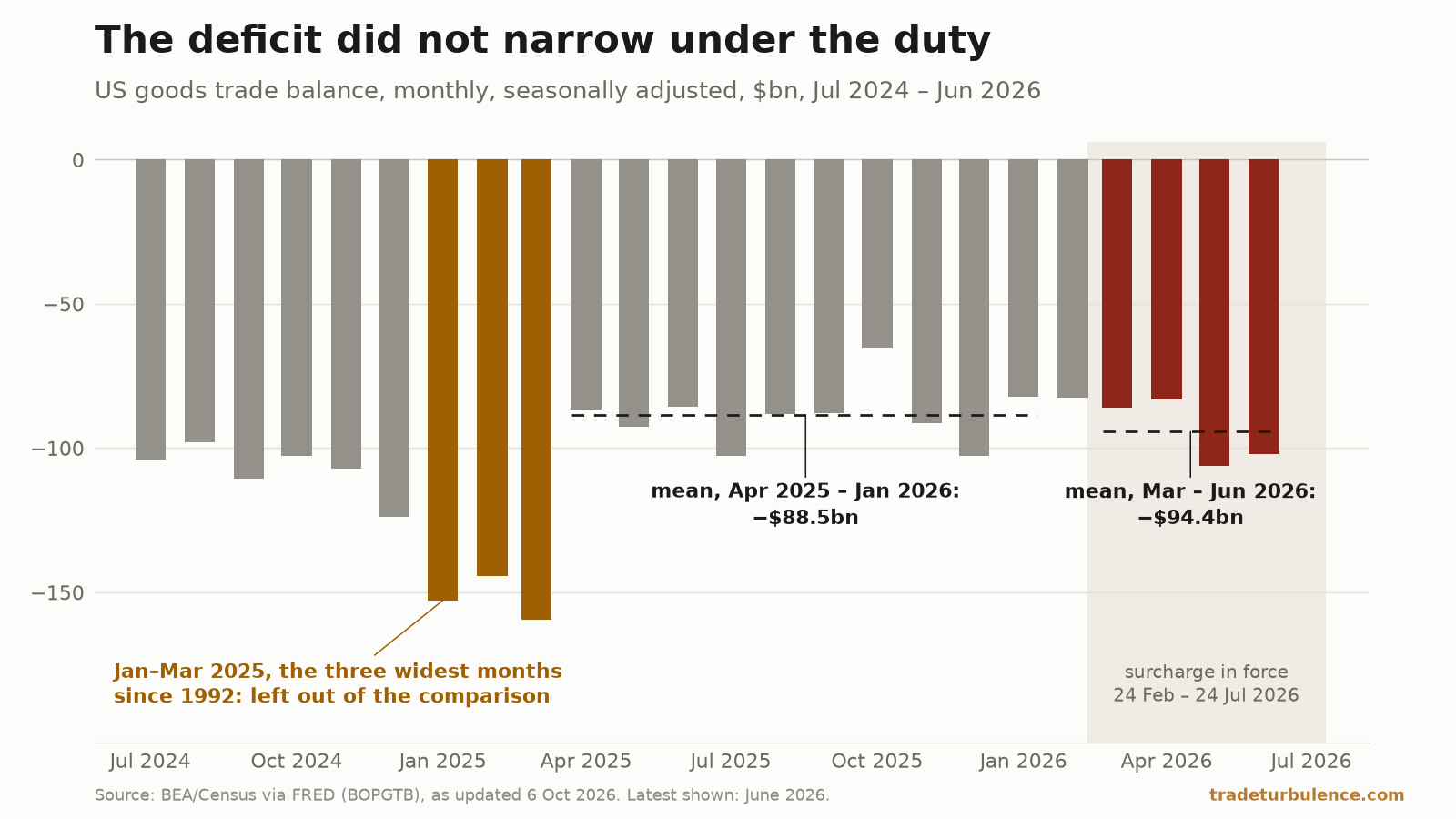
A 10% import surcharge took effect on 24 February 2026 to address what the proclamation called “fundamental international payments problems”. It expired at its 150-day statutory limit on 24 July. In the ten full months before it, from April 2025, the US goods deficit ran at $88.5bn a month. In the four full months under it, it ran at $94.4bn — $5.8bn a month wider, which is 0.58 of the ordinary monthly spread. The deficit did not narrow. The Stress Index reads 38.2, Settled, with trade activity at 12.1.
A tariff with a stated purpose and a clock
The measure has an unusually clear test attached to it, because the proclamation says what it is for and cites the numbers it is measured against. It records a goods trade deficit that “has grown by over 40 percent in the past 5 years alone, reaching $1.2 trillion in 2024”, a current account deficit of 4.0% of GDP against a 2.0% average from 2013 to 2019, and a net international investment position of −90% of GDP.
The first of those checks out: the goods deficit for calendar 2024 was $1,212,785m. For 2025 it was $1,259,621m.
The instrument was Section 122 of the Trade Act of 1974, a balance-of-payments authority that caps a surcharge at 150 days without an act of Congress. That clock is why the measure has a clean beginning and end: 24 February to 24 July 2026, with the Section 301 forced-labour duties taking effect the same minute it lapsed.
It was also ruled unlawful while it ran. The Court of International Trade held the surcharge invalid and enjoined collection; the Federal Circuit stayed that injunction in June, so the duty was collected for most of its life under a judgment saying it should not be. It expired on the statute’s clock rather than the court’s.
The monthly rate did not come down
Set the ten full months before the surcharge against the four full months inside it. The comparison starts in April 2025 deliberately, to exclude a first quarter discussed below, and ends in January 2026, the last full month before the duty applied. The figures are FRED’s as updated on 6 October 2026.
| Months | Mean monthly goods deficit | |
|---|---|---|
| April 2025 – January 2026 | 10 | −$88,541m |
| March – June 2026 | 4 | −$94,354m |
The gap is $5,813m a month, 6.6% of the level, against a standard deviation of $10,078m in the before period. In units of that spread the difference is 0.58. The deficit was wider under the surcharge, not narrower, but by less than an ordinary month’s variation, and on four months: March and April were narrower than the before average, May and June wider.
The $109bn improvement is the calendar
Read on twelve-month totals the same period looks like a success. The rolling goods deficit was $1,189.1bn in the year to January 2026 and $1,080.0bn in the year to June: an improvement of $109.1bn.
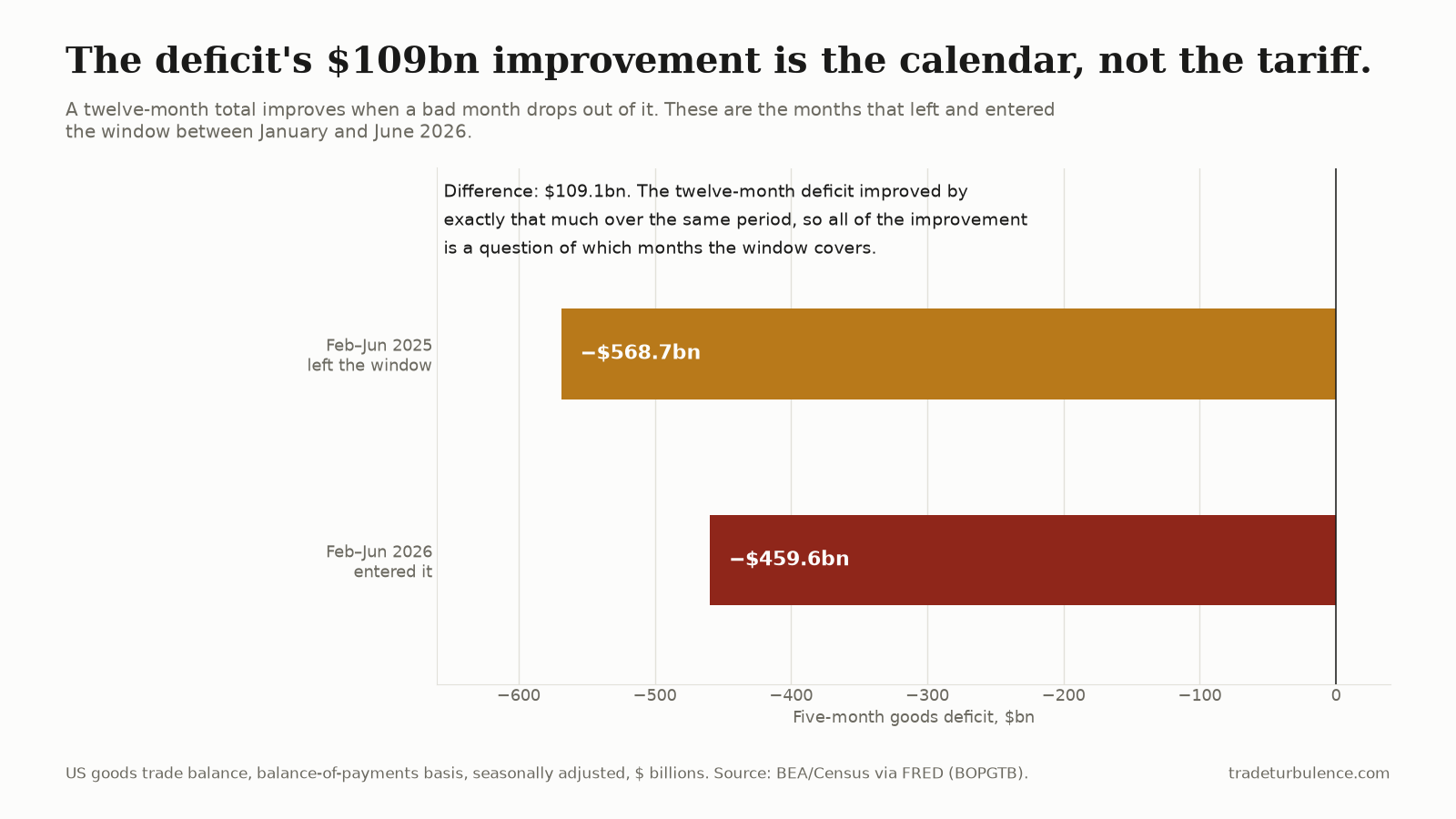
A twelve-month total changes for two reasons: what enters the window and what leaves it. Between January and June the months February to June 2025 left, carrying a combined deficit of $568.7bn, and February to June 2026 entered with $459.6bn. The difference is $109.1bn — the entire improvement, accounted for without reference to any policy at all.
What made the departing months so large is that January, February and March 2025 are the first, second and third widest goods-deficit months in the 414 months since 1992, averaging $152.2bn against $89.2bn across the rest of that year. This site has written before that the twelve-month deficit was narrowing while monthly swings grew violent. The decomposition above is the mechanical reason for the first half of that, and it is a caution against reading the narrowing as an outcome.
Most of the deficit was never covered
A 10% duty “on all imported articles” is narrower than it sounds. The proclamation exempts critical minerals, energy products, pharmaceuticals, certain electronics, passenger vehicles, aerospace products, several agricultural lines — and goods from Canada and Mexico entering under trade agreements.
Mexico and Canada alone supplied 30.1% of US goods imports in June, on the customs-basis country series. Only their goods entering duty-free under the USMCA were exempt, and these data do not show how much of the 30.1% that was. Those goods, plus energy, pharmaceuticals, vehicles and aerospace, take out much of what the deficit is actually made of. A surcharge that exempts the largest sources of the gap it is named after is not a strong test of whether tariffs close deficits, and that is the more useful reading of the comparison above.
What this cannot settle
Whether the surcharge did nothing, or did two things that cancelled. A gap of 0.58 of the ordinary monthly spread, on four months, is consistent with no effect and with offsetting effects — imports and exports falling together, or front-running in one month paying for a lull in the next. These data cannot separate those.
What would have happened otherwise. There is no counterfactual here. The deficit did not narrow; that is not the same as the surcharge having no effect on it, and the wider average is not evidence that the surcharge widened it.
Four months is four observations. The during-period mean rests on March to June 2026. July, the month the surcharge ended on the 24th, is not published yet.
What to watch
July and August goods data, due from early September. July contains the last three weeks of the surcharge and the first week of its replacement. August is the first clean month under the Section 301 regime, at 12.5% on China and 10% on Mexico with USMCA goods exempt.
Whether the twelve-month total turns. It bottomed at $1,050.3bn in April and has widened in the two months since, to $1,063.5bn and $1,080.0bn. The 2025 base effect is now exhausted, so from here the rolling figure starts measuring the present again.
The Federal Circuit. The surcharge expired, but the appeal over whether Section 122 authorised it did not, and the answer governs whether the authority is available the next time a payments deficit is declared a problem.
Correction, 14 October 2026: An earlier version compared the four full months under the surcharge with the eleven months from March 2025 to January 2026, and said the goods deficit ran at the same rate: $95.0bn a month before and $94.3bn during, $719m apart. March 2025 belongs to the first quarter the comparison said it left out. Starting in April 2025, on FRED’s data as updated on 6 October 2026, the deficit averaged $88.5bn a month before the surcharge and $94.4bn under it, $5.8bn a month wider, or 0.58 of the before period’s standard deviation. The piece now says the deficit did not narrow, and its title, standfirst, lede, table, chart and the passages that relied on “the same rate” have changed with it. It also treated all imports from Mexico and Canada, 30.1% of the total, as exempt. Only their goods entering duty-free under the USMCA were, and the data here do not show how much of the 30.1% that was. “Ended mid-way through” July now says the surcharge ended on the 24th.