Geopolitical Tensions Could Skyrocket Oil Prices to $150-$200 Per Barrel: What Investors Need to Know
Explore how escalating Middle Eastern conflicts could drive oil prices to unprecedented highs. Understand the potential impacts on global markets and investor strategies.
Executive Summary
The potential for oil prices to surge to between $150 and $200 per barrel due to geopolitical tensions is becoming a pressing concern for investors. Current oil prices, with Brent crude at $89 per barrel and WTI at $73.6 per barrel, could be dramatically affected by conflicts in the Middle East, particularly involving Israel and Iran. This article explores the historical context, potential future scenarios, economic implications, and strategic recommendations for investors navigating these turbulent conditions.
Current Market Situation
As of the latest reports, the oil market is seeing Brent crude prices at approximately $89 per barrel, while West Texas Intermediate (WTI) crude is trading around $73.6 per barrel. These figures reflect recent fluctuations driven by a mix of supply concerns and geopolitical uncertainties.
The recent stability in prices belies the underlying tension, as geopolitical risks, notably in the Middle East, pose a significant threat to market stability. The Strait of Hormuz, through which about one-third of the world’s seaborne oil passes, remains a critical chokepoint that could significantly impact global oil supplies if disrupted.
Geopolitical Tensions and Historical Context
The current geopolitical landscape is fraught with complexities, with the ongoing conflict between Israel and Iran at the forefront. Recent missile strikes and threats to critical oil infrastructure underscore the potential for market disruption. The situation draws parallels to the 1973 oil crisis, where a 14% reduction in oil supply led to a quadrupling of prices.
Patricia Schouker from the Lowy Institute warns of the risk of market complacency, emphasizing the potential for a global crisis if these tensions are not adequately addressed.
Potential Future Scenarios
Analysts suggest several scenarios where oil prices could surge past $150 per barrel, with worst-case projections reaching as high as $300 per barrel. The World Bank, however, predicts that in the absence of further escalation, prices could stabilize around $81 per barrel.
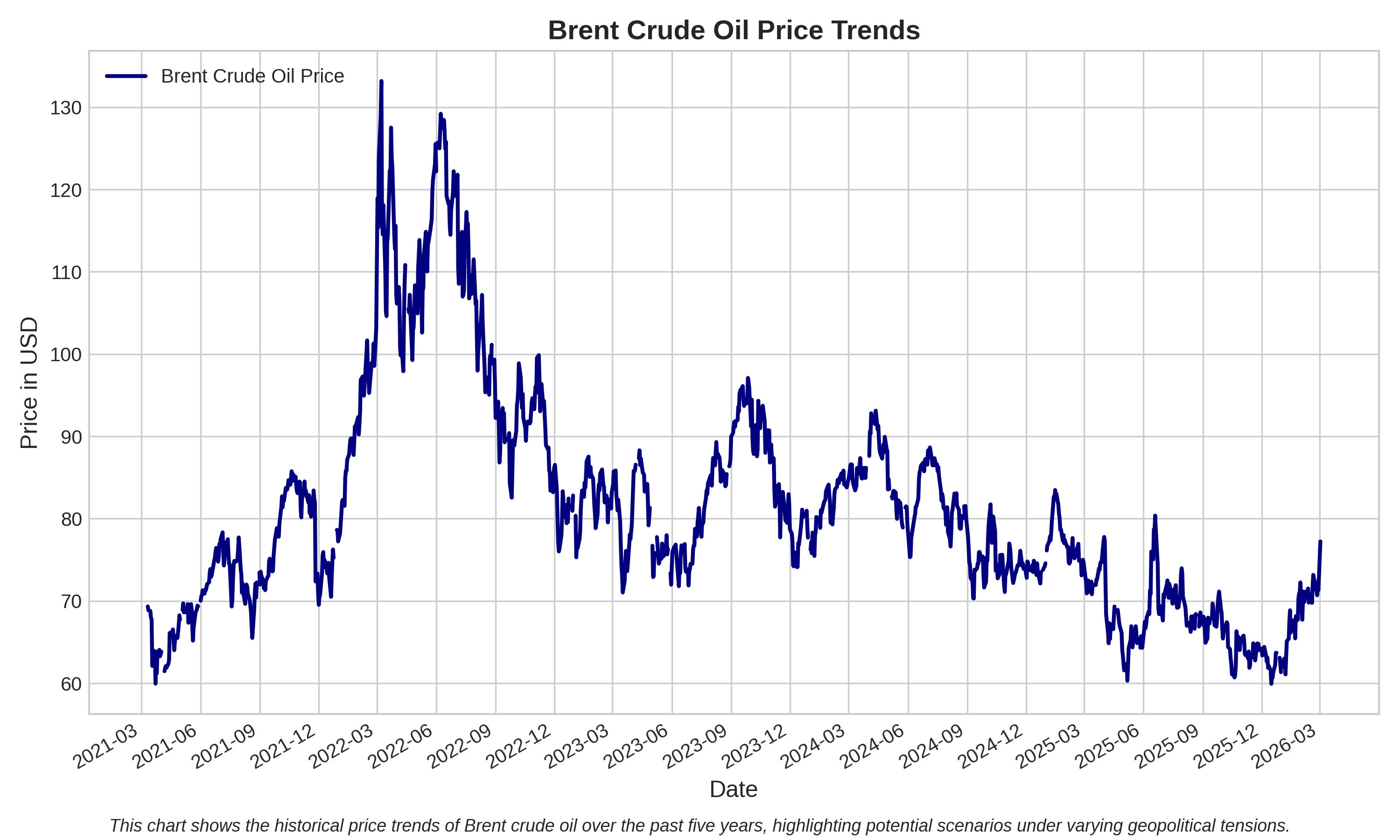
This chart shows the historical price trends of Brent crude oil over the past five years, highlighting potential scenarios under varying geopolitical tensions.
These scenarios depend heavily on the geopolitical climate and the global community’s response to potential disruptions in oil supply.
Economic and Market Implications
A significant surge in oil prices would have profound implications for the global economy. Higher oil prices typically lead to increased transportation and manufacturing costs, contributing to inflationary pressures. Indermit Gill, World Bank Chief Economist, cautions that such a scenario could trigger a dual energy shock reminiscent of the 1970s, slowing economic growth and affecting stock market stability.
Investor Strategies and Recommendations
Investors must adopt strategic foresight to navigate these potential upheavals. This involves understanding both macroeconomic forces and sector-specific dynamics. Jim Cramer highlights the interconnected nature of U.S. and global oil prices, suggesting that geopolitical events could lead to significant market shifts.
Investors should consider diversifying portfolios, hedging against oil price volatility, and exploring opportunities in sectors that may benefit from rising energy prices, such as renewable energy and mining.
Conclusion
The possibility of oil prices soaring to between $150 and $200 per barrel due to geopolitical tensions underscores the importance of vigilance and adaptability in investment strategies. Staying informed and anticipating market shifts will be crucial for investors as they navigate this potentially volatile landscape.
Previous Article: US-China Tariff Escalation: The Ripple Effect on Global Tech Supply Chains