TSMC shipped 9.6% more wafers. It took in 41.2% more dollars
TSMC took in 41.2% more dollars in July–September than a year earlier, on 9.6% more wafers. Revenue per wafer rose 28.8%, its biggest rise in 15 quarters.
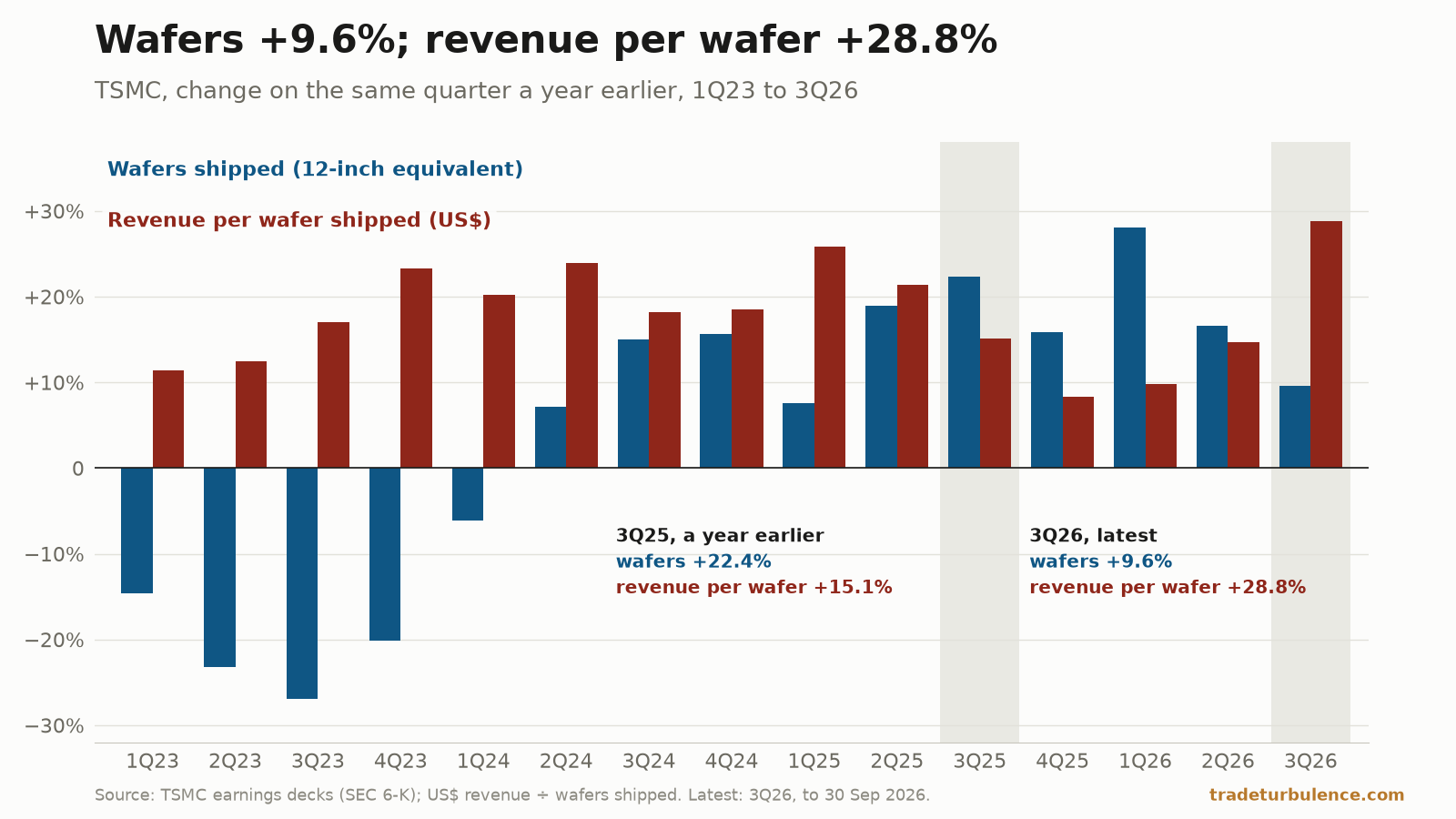
TSMC shipped 4,476 thousand 12-inch-equivalent wafers in July–September 2026, 9.6% more than a year earlier, and took in US$46.72bn, 41.2% more, its filings with the SEC show. Revenue per wafer shipped rose 28.8%, to US$10,438: more than in any of the 14 quarters before it, and 12.6% on the quarter, more than in any of the 17 before. A year earlier the growth ran the other way, with wafers up 22.4% and revenue per wafer up 15.1%. About three-quarters of this year’s dollar growth came from what each wafer brought in.
What happened
On 15 October TSMC reported third-quarter revenue of NT$1,494.24bn, 50.9% more than a year earlier and 17.6% more than in the second quarter, in a filing with the SEC. In dollars it was US$46.72bn, up 41.2% on the year and 16.2% on the quarter. This is delivered business, not an announcement: the revenue was billed in the quarter. The filing notes that the board had not yet approved the figures. The three months TSMC reports to the Taiwan Stock Exchange add up to the same total, and August’s NT$514.81bn was the highest month in the site’s series.
TSMC had guided the quarter at US$44.6bn to US$45.8bn three months earlier; it came in US$0.92bn above the top of that range. “Our business in the third quarter was supported by strong demand for our leading-edge process technologies,” Wendell Huang, the chief financial officer, said in the release.
The site’s weekly of 19 October gave the 50.9% in one paragraph and said it had not tested what TSMC’s guidance implies. This piece does both: where the growth came from, and how TSMC’s guidance has compared with what it delivered.
How the effects travel
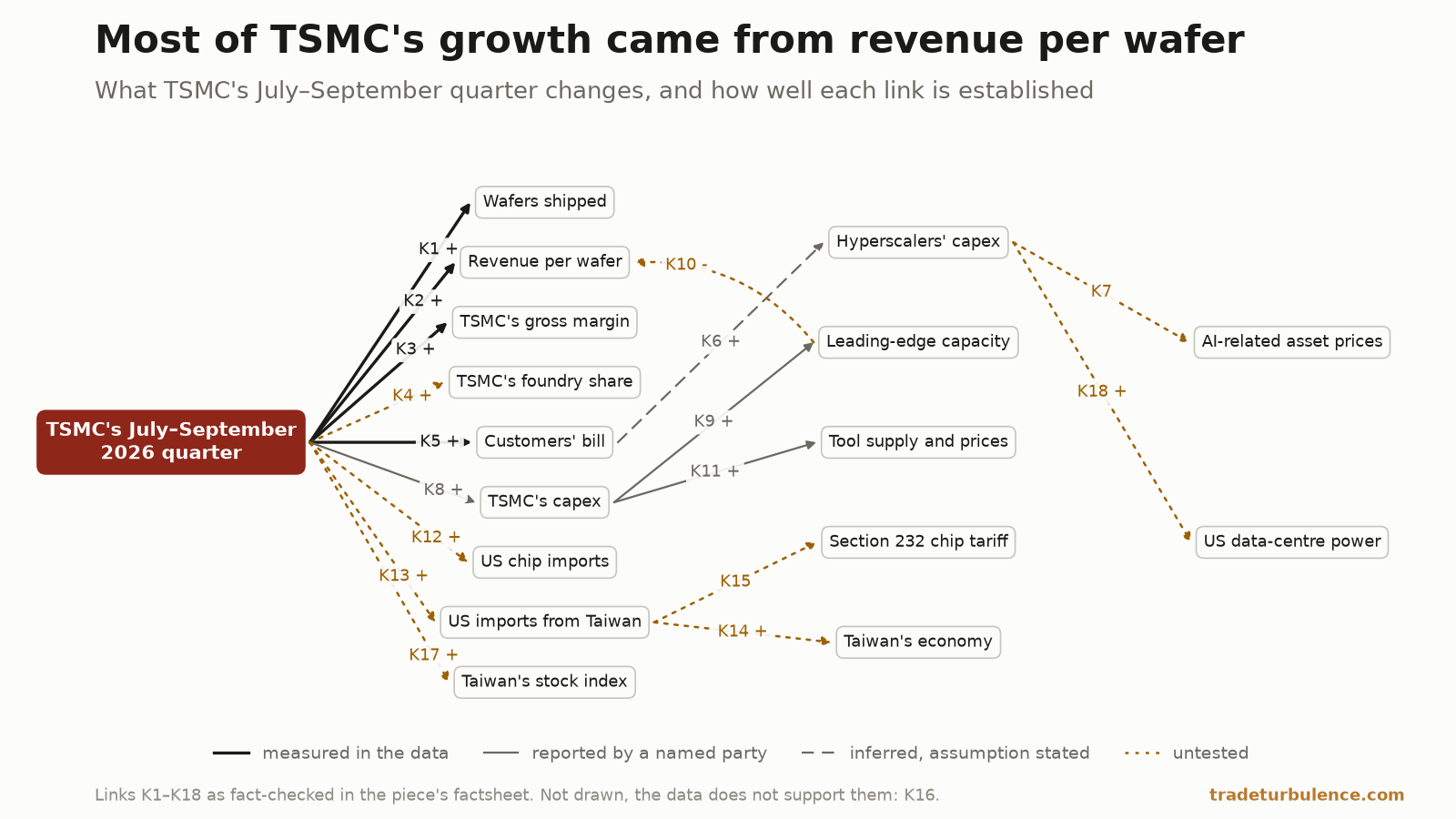
The quarter’s first-order effects are inside TSMC’s own figures. Wafer volume rose, more slowly than a year earlier; revenue per wafer rose faster than at any point in the filings examined; gross margin stood 6.9 points above a year earlier; and the bill landed on customers based in North America and in high-performance computing, which TSMC groups with AI (“HPC/AI applications”). TrendForce, a market-research firm, put TSMC’s share of the foundry market at 72.5% in the second quarter, before this one; whether this quarter raised it is untested until TrendForce’s next ranking. TSMC says it is spending the cash on capacity, with a capital budget of US$60bn to US$64bn this year.
Second-order effects run through three channels. The first is the buyers: the accelerators made on TSMC’s HPC wafers are bought, inside servers, mostly by the largest cloud companies, so their capital spending carries the bill. That rests on an assumption, because TSMC does not name its customers. The second is supply. TSMC says “the gap between demand and supply are still quite big”, and its finance chief says tool supply is tight and tool prices are rising. If capacity caught up with demand, the scarcity that lets each wafer bring in more would ease; that loop is untested. The third is trade. If this quarter’s TSMC-made chips leave Taiwan as integrated circuits and inside servers, they would show in US imports one to two quarters later; that is untested, and the trade data will not say whose chips they are. Whether those imports change Taiwan’s output or the US Section 232 tariff on chips is not tested either.
One channel the data rejects. Export receipts on this scale, converted into Taiwan dollars, would push the currency up. It went the other way: TSMC’s quarter averaged NT$31.98 to the US dollar against NT$29.91 a year earlier.
Revenue per wafer rose 28.8%, more than in any of the 14 quarters before
TSMC’s presentation to investors reports wafers shipped each quarter in 12-inch equivalents. Dividing revenue in dollars by that count gives revenue per wafer shipped: US$10,438 in the third quarter, against US$8,103 a year earlier and US$9,271 in the second quarter. The annual rise of 28.8% is larger than in any of the 14 quarters from early 2023 that we compared, and the quarterly rise of 12.6% larger than in any of the 17 from the second quarter of 2022. In Taiwan dollars the rise was 37.8%.
Volume did grow. The 4,476 thousand wafers were the most of any quarter from the start of 2022, as far back as we read the filings. But they were only 12.6% more than in the third quarter of 2022, when dollar revenue was US$20.23bn; revenue is now 2.31 times that, and revenue per wafer about twice the US$5,091 of then. Of this year’s 41.2%, wafers account for a factor of 1.096 and revenue per wafer 1.288; measured in logarithms, about three-quarters of the growth came from revenue per wafer. The split has turned within a year: wafers grew 22.4% on the year in the third quarter of 2025, 28.1% in the first quarter of 2026 and 9.6% now, while the annual rise in revenue per wafer went from 15.1% to 28.8%.
The mix moved to the newest processes. Chips at 7 nanometres and finer made 79% of wafer revenue; 3nm was 33%, against 23% a year earlier, and 2nm, absent then, was 8%. High-performance computing made 68% of revenue, against 57% a year earlier.
TSMC did not say on its call whether it had raised prices. An analyst cited “reports of significant price increases across your mature and advanced nodes”. C.C. Wei, TSMC’s chairman and chief executive, answered that “our pricing strategy is very strategic. It also depends on the market segment, depends on the location, and depends on the technology”. TrendForce reported growth “in both wafer shipments and ASPs”, average selling prices, for TSMC in the second quarter.
On the site’s monthly series, which starts in January 2019, the third quarter is the highest quarter, 17.6% above the second. Its NT$223.86bn addition is the largest of any quarter, 1.64 times the second quarter’s NT$136.28bn. The 17.6% rise is the second-largest of 30 quarterly changes; only the third quarter of 2019, at 21.6%, was larger. The 50.9% annual growth is the fastest of the 27 quarters since annual comparisons begin, ahead of 47.9% in the third quarter of 2022. It has quickened for three quarters running: 20.5%, 35.1%, 36.0%, then 50.9%.
Part of that is the currency. TSMC’s quarter averaged 6.9% more Taiwan dollars per US dollar than a year earlier. In dollars the quarter is still the highest in the filings from 2022 on, US$46.72bn against US$40.20bn in the second quarter, and its US$6.52bn addition the largest. What is not a record in dollars is the rate of growth: the second quarter of 2025 grew faster, 44.4% on the year and 17.8% on the quarter.
TSMC has landed inside or above its own range for 15 quarters
TSMC gives a revenue range for the coming quarter with each set of results. In the 15 quarters from the first of 2023, revenue landed inside or above that range every time: above the top nine times, exactly on it once and inside it five times, never below. The third quarter’s beat, US$0.92bn above the top, was the largest in dollars; at 2.0%, it was third in percentage terms, after the second quarters of 2025 (3.0%) and 2024 (2.1%). That is a record of past quarters, not a forecast.
For the fourth quarter TSMC guides US$52.3bn to US$54.3bn. Huang described it as “a 14% sequential increase or a 58% year-over-year increase at the midpoint”, slower on the quarter than the 16.2% just reported. Wei said: “we now expect our full year 2026 revenue growth to be around 44% year-over-year in US dollar terms”. On TSMC’s quarterly figures, our arithmetic, that implies about US$53.5bn in the fourth quarter, inside the range.
Capital spending was US$13.84bn in the quarter and US$40.64bn in the first nine months. Huang said: “we reiterate our full year 2026 capital budget to be between USD60 billion and USD64 billion”. That leaves US$19.4bn to US$23.4bn for the fourth quarter. Wei was more cautious about the year after: “we continue to observe consumer and price-sensitive end market segments are being challenged due to the impact of rising component prices and more economic uncertainties. As such, we are being prudent in our business planning going into 2027”.
US imports from Taiwan set a record in July. Whose chips they carry is not recorded
US chip imports, integrated circuits under heading 8542, reached US$5.485bn in August, the highest month since the Census Bureau series the site holds starts in January 2019; the previous high was June’s US$5.023bn. July and August together were 61.0% above the same two months of 2025. In August, Taiwan supplied 33.7% of them, US$1.851bn, ahead of Ireland, South Korea, Israel and Singapore.
Server imports reached US$33.61bn in July, the highest month in the Census series the site holds, which also starts in January 2019; the previous high was May 2026’s US$25.81bn. They were US$30.30bn in August; July and August together were 88.6% above a year earlier. Most of August’s came from Mexico (62.1%); Taiwan supplied 26.1%.
Total US goods imports from Taiwan were US$25.67bn in July 2026, the highest month in a series that starts in January 1985; the previous high was US$24.69bn in December 2025. July and August were 35.2% above a year earlier, and the 12 months to August came to US$269.1bn, up 68.4%. Machinery, the customs chapter that holds computers and servers, made 71.4% of the United States’ imports for consumption from Taiwan over those 12 months.
On this piece’s assumption that wafers take one to two quarters to reach the US as chips and servers, July and August carried earlier quarters’ output, not this quarter’s, which would show from October’s figures on. Even then the data will not say whose chips they are. Census records the country, not the chipmaker, and servers assembled in Mexico carry their chips past Taiwan’s figures. Since 2020 the annual growth of TSMC’s revenue and of US imports from Taiwan have moved together only loosely: a correlation of 0.38 over 26 quarters.
Who gains and who pays
TSMC’s gross margin was 66.4%, against 59.5% a year earlier and 67.7% in the second quarter. Revenue rose 50.9% on the year while the cost of revenue rose 25.0%. TSMC put the fall from the second quarter “primarily” down to “the margin dilution from the initial ramp-up of N2 technology”. It gave no reason for the rise on the year, and the data cannot separate prices, the node mix, how fully the fabs ran and the weaker Taiwan dollar. It guides 65% to 67% for the fourth quarter and expects its overseas fabs to dilute gross margin by “closer to 2%” this year, widening “to 3% to 4% in the next few years”.
Rivals grew too. In TrendForce’s estimates for the second quarter, TSMC’s revenue rose 12.1% on the quarter against 11.5% for the ten largest foundries together, for a 72.5% share of the foundry market; SMIC’s rose 20%, to a 5.4% share, and Samsung’s foundry 1.8%, to 5.9%, though Samsung raised prices for its most advanced nodes.
The bill falls first on TSMC’s customers. Companies based in North America paid 79% of TSMC’s revenue, against 76% a year earlier; HPC revenue, on TSMC’s rounded shares, was about 68% higher in US dollars than a year earlier, between 66% and 71% given the rounding. Four hyperscalers, Microsoft, Alphabet, Amazon and Meta, spent US$165.05bn on property and equipment in the quarter to June, 87.0% more than a year earlier and the highest quarter in a series that starts in 2019. If, as assumed, most of TSMC’s HPC wafers end in their data centres, the bill passes on to them. The International Monetary Fund’s Global Financial Stability Report of 13 October warns: “Weaker or less durable investment and profitability in artificial intelligence could lead to a correction in AI-related” asset prices.
The US tariff actually charged on imports from Taiwan was low in August: duty came to 2.937% of their value, by the site’s Taiwan page, and 84.8% of the past 12 months’ imports from Taiwan entered duty-free. Proclamation 11002 of 14 January set a 25% duty on “certain advanced computing chips” only “when such importation does not contribute to the buildout of the United States technology supply chain”, and asked for an update on data-centre semiconductors by 1 July 2026; a search of the Federal Register on 20 October found no proclamation changing it since.
What this cannot settle
Revenue per wafer is not a price. It is all of TSMC’s revenue divided by wafers shipped, so it mixes price, the share of 2nm and 3nm wafers, and revenue that is not wafers, such as advanced packaging. TSMC does not publish a wafer price.
The Taiwan-dollar growth is partly the currency. In US dollars, growth was 41.2%, and the second quarter of 2025 was faster.
Whether this quarter’s chips reach US imports is untested. US trade data run to August, before this quarter’s wafers could arrive on a lag of one to two quarters. The partner breakdown for chip imports on the site is for August only, so this piece cannot say whether Taiwan’s share rose.
Whether the spending earns its return is untested. The IMF’s warning is about a risk, not an outcome. Whether TSMC’s results lifted the TAIEX, which closed at 46,822.08 on 19 October, 65.8% above its last close of October 2025, is also untested: the index moves on much else. So is the loop by which new capacity would erode revenue per wafer.
Jobs. No public series ties employment to TSMC’s output; its annual headcount and Taiwan’s manufacturing employment would be the sources, and this piece has neither.
What to watch
Early November: TSMC’s October revenue. TSMC filed each month’s figure with the SEC between the 8th and the 13th of the following month this year. Above NT$514.81bn, August’s figure, October would be the highest month in the series.
The hyperscalers’ July–September filings. Their capital spending was up 87.0% on the year in the quarter to June. A slower rise would test the demand behind TSMC’s HPC revenue and the IMF’s concern. The site’s electricity price series, US$0.196 a kilowatt-hour in September, 4.3% above September 2025, is one place growing data-centre load would show, among many other causes.
Census figures from October on. On the lag assumed here, one to two quarters, they are the first that could carry this quarter’s chips. Chip imports above August’s US$5.485bn, or imports from Taiwan above July’s US$25.67bn, would be new records; Census will still not say whose chips they are. A proclamation modifying Proclamation 11002 would show the US changing the chip tariff. Taiwan’s first estimate of July–September output will show whether net exports carried growth. TrendForce’s third-quarter ranking will show whether TSMC’s 72.5% share held.
Mid-January: TSMC’s fourth quarter. TSMC reported its last three fourth quarters on 18 January 2024, 16 January 2025 and 15 January 2026. A result below US$52.3bn would end a run in which none of the 15 quarters checked fell below TSMC’s range. Revenue per wafer below US$10,438, or capital spending below US$19.4bn, would mark a turn.